

They Went In. But Are They Okay?
When attendance doesn't tell us the whole story
Getting through the school door can look like success. Yet what school sees during the day may be very different from what families see before and afterwards.
This ELM Conversation looks at the 24-Hour Child: the full experience across home, school and recovery. It asks what attendance may be costing a child, why different settings can see different presentations, and how those perspectives can be brought together.

Read and Reflect
Take this conversation at your own pace, with space to reflect on what a child’s experience looks like across home, school and the whole day.
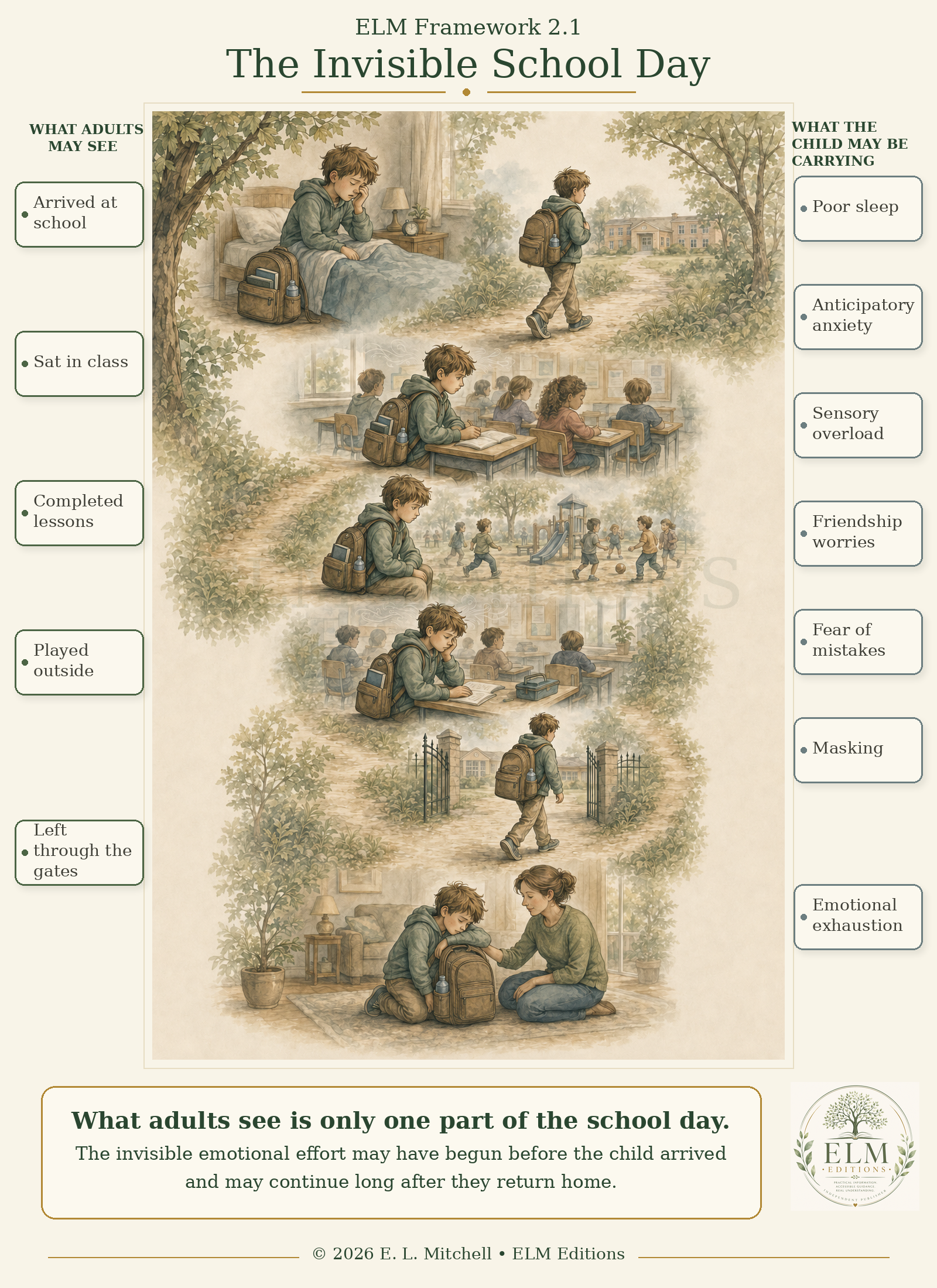
What Happens Before the School Door Matters
A school may see a child arrive at 8:45am. A parent may have been supporting that child since 6:30am. Before leaving home, there may already have been distress about going in, feeling unwell, where they will sit, who will be there or what the day might bring.
Sometimes the distress is obvious. At other times, the child becomes quiet, moves slowly, cannot eat, repeatedly checks the time or needs the morning to follow an exact order. By the time they reach school, an enormous amount may already have happened.
The school day does not begin at the school gate.
The School Sees Another Child
The child who could not get dressed that morning may walk into school and smile. They may answer questions, complete work or laugh with a friend. Adults may understandably think they seem fine.
But appearing okay and being okay are not always the same. Some children hold themselves together by masking discomfort and suppressing anxiety while navigating noise, expectations, transitions, friendships and uncertainty.
The classroom may see participation. It may not see the energy that participation requires.
And Home May See Another Child Again
The child who appeared settled at school may become silent, angry or tearful on the way home. They may retreat to their bedroom, struggle with ordinary demands, find food or homework impossible, or lose sleep. Sometimes the collapse is immediate. Sometimes it arrives hours later.
This does not mean either account is wrong. School may genuinely see participation while home sees a child who can no longer hold themselves together. Both can be true.
The 24-Hour Child
The ELM Method starts from a simple principle: no single environment sees the whole child. School holds one part of the picture. Parents and carers hold another. Professionals hold other pieces, while the child carries the experience of them all.
If we judge coping only through the hours we witness, important information disappears between settings. A better question is not only, “Are they managing at school?” but, “What does managing at school cost them across the rest of the day?”
That question shifts attention towards whether the child’s whole experience is manageable and sustainable.

Parents Are Evidence Holders
Parents and carers see what a lesson observation or short appointment cannot capture: the morning before school, the journey, the return home, recovery, sleep, weekends and the approach of the next school day.
That information is part of understanding whether education is currently sustainable. When home and school see different presentations, the useful response is: “We are seeing something different. Let’s put the two pictures together.”
Parents are not reporting a separate story. They hold another part of the evidence.
Schools Are Evidence Holders Too
Schools also hold information families cannot see. They observe lessons, transitions, peer relationships, engagement across the week, the adults a child seeks out and the situations where something changes.
The aim is not to decide whether home or school understands the child better. It is to use both accounts to build a fuller picture. A difference between settings may itself be valuable evidence.

Different Pieces. Same Child
A child should not have to fall apart in every setting before their difficulty is taken seriously. A successful return should not be measured only by whether they crossed the threshold.
Attendance tells us where a child was. It does not always tell us what it took to be there. The more useful question is: “How are they doing across the whole 24 hours?”
Morning, school, the journey home, recovery, sleep and the next day all matter. Together, they show whether the child’s current experience is manageable and sustainable.
A Small ELM Reflection
For parents and carers, this week may be an opportunity to notice the whole day rather than focusing only on whether your child attended. What happened before school? What happened afterwards? How long did recovery take? What helped? What seemed to make the following morning easier or harder? These observations can help build a clearer picture over time.
For educators, one additional question can open an important conversation with families: “What are you seeing at home after the school day?” If home and school appear to be seeing very different children, we do not immediately need to decide which account is correct. Instead, we can become curious about why that difference exists.
And for professionals supporting a child across services, consider what information may currently sit outside your own window of observation. What might become clearer if the experiences of the child, family and school were brought together?

Different perspectives don't have to compete. They can complete the picture
A child is more than the part of their day any one adult witnesses. When families, educators and professionals bring their evidence together, the conversation moves away from proving whether a child is struggling and towards understanding what support they need.
That is where meaningful support can begin.
ELM Conversations bring lived experience, education and professional understanding closer together by looking beyond the part of the child any one person can see.